
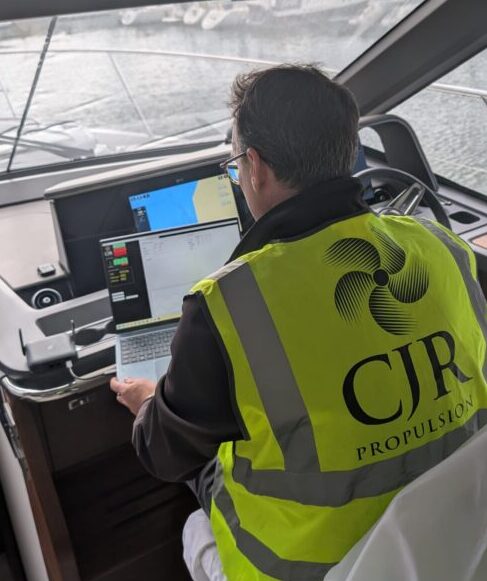
The latest version of CJR Propulsion’s TrialsApp now connects directly to a vessel’s NMEA 2000 network, automating data collection and making sea trials simpler, more efficient, and more reliable.
CJR Propulsion will launch TrialsApp v3 at METSTRADE 2026, introducing a completely redesigned sea trials data collection system that makes it easier than ever for naval architects and marine engineers to capture accurate engine, navigation, and vibration data.
At the heart of the new system is direct connectivity to a vessel’s NMEA 2000 CAN bus network. This allows TrialsApp v3 to collect compatible engine and navigation data automatically from onboard systems. By removing the need for engineers to enter readings manually or rely on a tablet’s GPS receiver, the new system significantly simplifies the data collection process and helps deliver more consistent, reliable results.
Alex Stevens, CJR Propulsion’s Technical Sales Director, explains: “CJR developed TrialsApp to be used internally, but we quickly had marine engineers, boatbuilders, and naval architects asking us if they could purchase the system to use themselves to better understand how their vessels perform in real-world conditions.
“In this newest iteration, we’ve completely rebuilt TrialsApp with a new architecture, moving to a Windows-based platform and introducing direct connectivity to the vessel’s onboard systems. Data no longer needs to be entered manually – something that sometimes caused issues when testing in rough seas. And the new system eliminates any issues with GPS reliability onboard, especially for metal vessels where signal reception can be compromised. If you’d like to find out more, come and chat to us at Metstrade. We’ll be there all week on stand 07 – 419 in the Superyacht Hall.”
Less manual input, more reliable data
The biggest improvement in TrialsApp v3 is its ability to connect directly to a vessel’s NMEA 2000 network.
This means compatible engine information can be collected automatically, without engineers having to manually enter readings during a trial. It makes the process considerably more straightforward, reduces the potential for input errors, and allows engineers to focus on operating the vessel and monitoring its performance.
The system can also average the information collected during a trial, helping to produce a more consistent dataset for analysis.
Navigation data is accessed through the same onboard network, removing the need to depend on the tablet’s internal GPS receiver for speed and course information. This is particularly beneficial when testing metal-hulled vessels or operating in conditions where obtaining reliable GPS information can be challenging.
By bringing engine and navigation data together through a single onboard connection, TrialsApp v3 makes collecting the information needed for meaningful performance analysis easier and more dependable.
Advanced vibration analysis retained
Alongside its improved data collection capabilities, TrialsApp v3 retains the detailed vibration analysis functionality that has become an important part of the system. The new version incorporates three vibration sensors, measuring acceleration at a sampling frequency of 400Hz. Using Fast Fourier Transform (FFT) analysis, the system generates plots showing vibration frequencies, alongside peak acceleration and velocity readings.
This provides engineers with a detailed picture of how a vessel’s propulsion system behaves at different engine loads, helping to identify potential sources of unwanted vibration.
The information is particularly valuable when comparing propeller designs, investigating performance issues or assessing the impact of changes to a vessel’s propulsion system.
Supporting better engineering decisions
TrialsApp is used internally by the CJR Propulsion engineering team to compare actual vessel performance against Computational Fluid Dynamics (CFD) predictions, evaluate the impact of sterngear design changes, and to collect valuable data to inform future projects.
The system is also available for boatbuilders and naval architects to purchase and operate within their own engineering teams. Previous versions have been adopted by leading international boatbuilders including Princess Yachts, Sunseeker, and Gulf Craft, as well as several naval architecture practices.
For production boatbuilders, access to consistent and repeatable sea trial data is particularly valuable. It allows different vessel configurations to be compared, potential issues to be identified and performance improvements to be tracked across successive models. It also provides objective engineering information to support design decisions and demonstrate vessel performance to customers.
With NMEA 2000 integration making data collection simpler and more consistent, TrialsApp v3 offers users an easier way to build a reliable picture of vessel performance.
Discover TrialsApp v3 at METSTRADE
Despite the extensive redesign and introduction of new hardware and software capabilities, TrialsApp v3 is expected to be offered at a price comparable to the previous version.
Visitors to METSTRADE will have the opportunity to see the new system in action and discover how direct connectivity to onboard systems can simplify their own sea trials.
To arrange a demonstration of TrialsApp v3 or discuss purchasing a system for your own sea trials, chat to the CJR Propulsion team at stand 07 – 419 in the Superyacht Hall METSTRADE or get in touch directly: [email protected]